
The GI Bill and the Suburbs: 6 Landmarks of the Postwar Boom
1. Kaiser Community Homes (Panorama City, California)
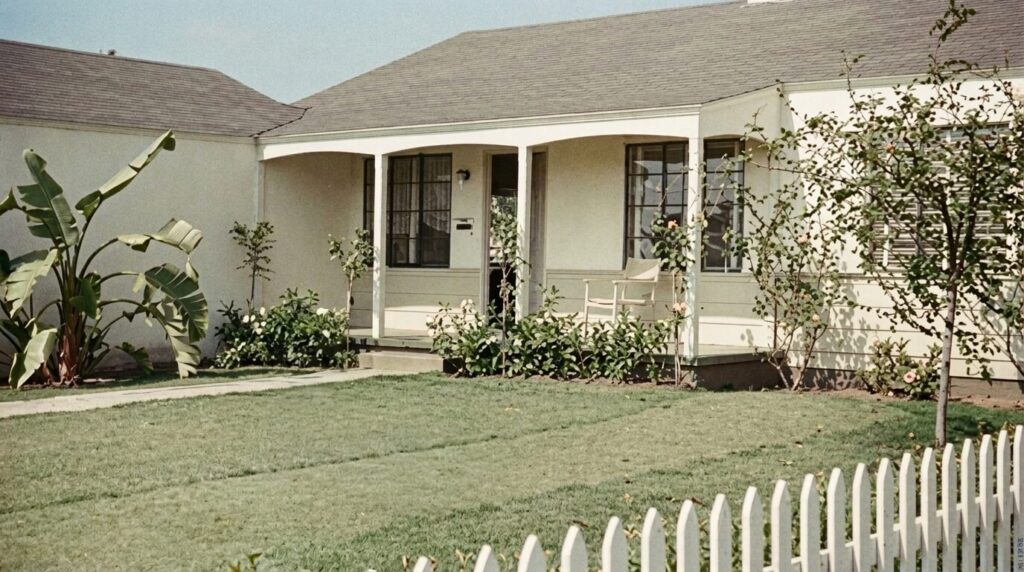
The Shipyard Suburb Immediately after the war, industrialist Henry J. Kaiser (famous for building Liberty Ships) teamed up with developer Fritz Burns to solve the housing crisis. Starting in 1945, they applied the exact same mass-production, pre-fabrication techniques used in shipbuilding to residential housing. In Panorama City, they built thousands of homes featuring standardized floor plans but varied rooflines (combining Minimal Traditional and early Ranch styles) to avoid visual monotony. Historical archives are packed with incredible, royalty-free images of these early pre-fab walls rolling off factory lines and being tilted into place.
2. The 1947 Levittown Cape (Levittown, New York)

The Blueprint of the American Dream While we touched on William Levitt’s wartime experiments, 1947 is when Levittown officially opened to civilian veterans, fundamentally changing America. Levitt broke the building process down into 27 distinct steps, utilizing non-union labor to finish up to 30 houses a day. The original 1947 model was a brilliant, highly simplified Cape Cod with the kitchen moved to the front so mothers could watch their children play in the street. The transformation of these Long Island potato fields into a 17,400-home mega-suburb is one of the most thoroughly photographed events in US history, providing endless open-source imagery.
3. The Lustron Houses (Columbus, Ohio / Nationwide)
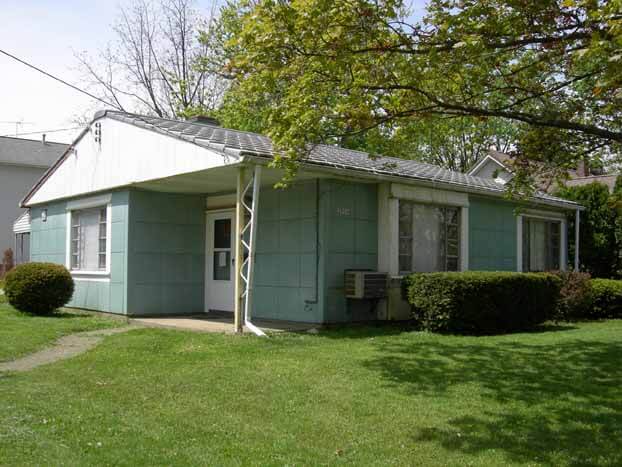
The Steel House of the Future In 1947, the Lustron Corporation offered a radical, futuristic solution to the postwar housing crisis: a house made entirely of porcelain-enameled steel. Built in a former warplane factory, these homes were shipped on customized trucks and assembled on concrete slabs in days. They were marketed as fireproof, rustproof, and completely maintenance-free (you could literally clean the exterior walls with a garden hose). While the company eventually went bankrupt, the surviving pastel-colored steel homes are highly protected historic landmarks with vast, copyright-free architectural documentation available.
4. Park Forest (Park Forest, Illinois)
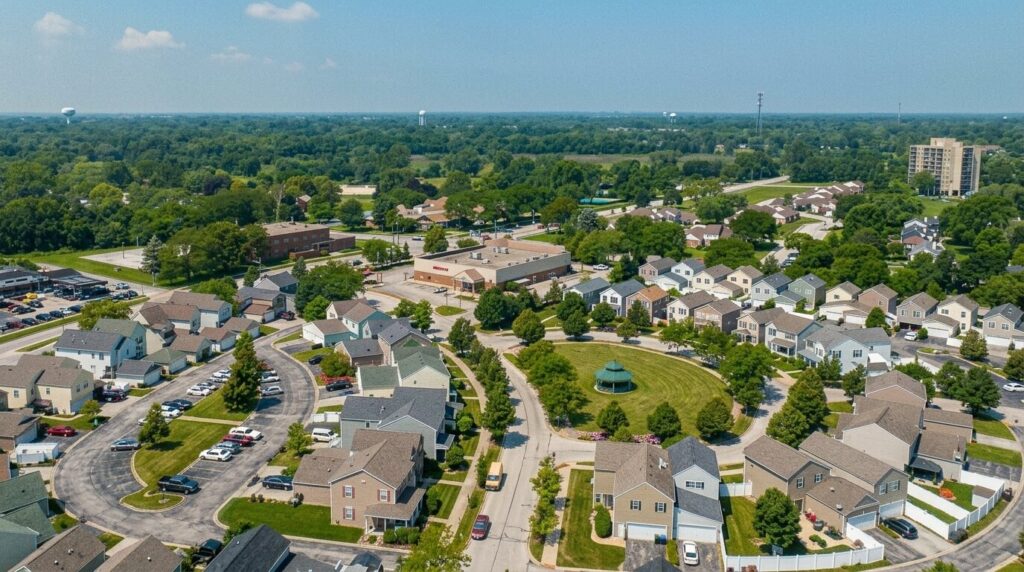
The Master-Planned GI Town Developed starting in 1947 just south of Chicago, Park Forest was the first fully planned, privately financed postwar community in America. Rather than just building houses, the developers built a complete town from scratch—including schools, churches, and one of the nation’s first outdoor shopping malls. The residential layout permanently killed the traditional urban grid, utilizing looping streets and cul-de-sacs to prioritize automobile safety and privacy. As a legendary sociological experiment, the federal archives feature beautiful, public domain photography of its early GI residents.
5. The Early Eichler Tracts (Sunnyvale, California)
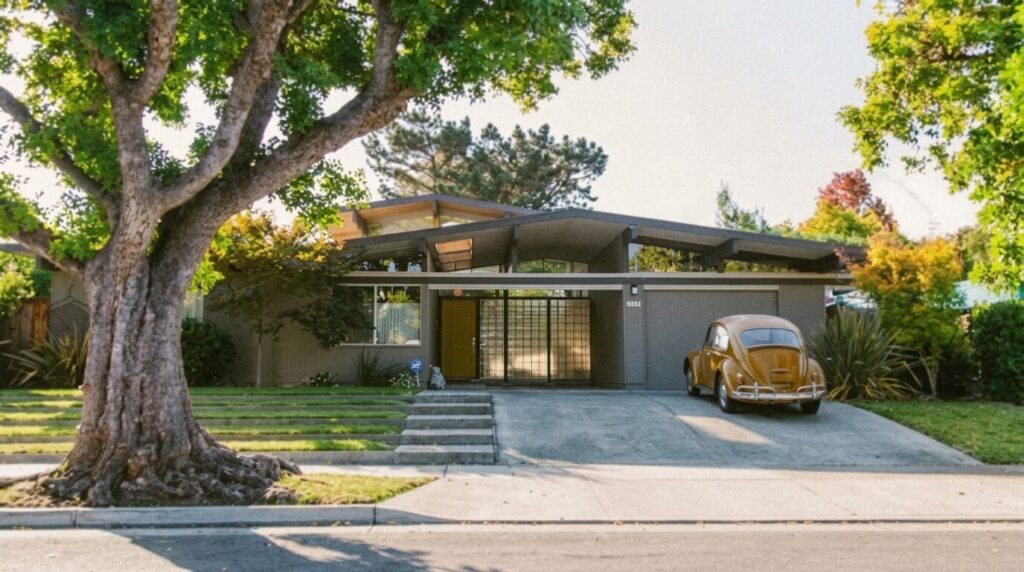
Modernism for the Masses In 1949, developer Joseph Eichler began building tract homes in California that completely rejected the traditional Cape Cod and Colonial shapes. Inspired by Frank Lloyd Wright, Eichler brought Mid-Century Modernism to the middle class. His post-and-beam construction allowed for open floor plans, flat or low-slung A-frame roofs, and massive floor-to-ceiling glass walls that blurred the line between the living room and the backyard. Eichler homes have a massive cult following today, and Wikimedia Commons features a wealth of free-to-use photography of his iconic, light-filled designs.
6. Case Study House #8 / The Eames House (Pacific Palisades, California)

The High-Design Postwar Experiment In 1945, Arts & Architecture magazine launched the “Case Study House Program,” commissioning famous architects to design cheap, replicable, modern homes to solve the postwar housing crisis. The most famous result was Case Study House #8, completed in 1949 by Charles and Ray Eames. The house was constructed entirely out of off-the-shelf, prefabricated industrial parts (steel beams, glass, and brightly colored panels) ordered from catalogs. It proved that mass-produced materials could create breathtaking architecture. As a National Historic Landmark, royalty-free structural photography of this modernist icon is easily accessible.

