
Mail-Order Masterpieces: 6 Iconic Kit Homes & Bungalow Neighborhoods
The 1915 era revolutionized the American housing market. Thanks to companies like Sears, Roebuck & Co. and Aladdin, the beautifully designed Craftsman bungalow was no longer just for the wealthy, it could be ordered from a catalog and shipped by boxcar. To best illustrate this era, it is highly effective to feature both standout individual kit homes and the famous “bungalow belts” where they were built en masse.
Here are 6 heavily documented, historically protected examples with abundant public domain and Creative Commons imagery available:
1. The Elgin Sears House District (Elgin, Illinois)

The Kit Home Capital of the Midwest If you want to show what a classic 1915 mail-order street looks like, Elgin is the ultimate visual source. The city boasts one of the largest concentrations of authenticated Sears catalog homes in the country, with over 200 documented houses. Here you can find pristine, preserved examples of Sears’ most popular Craftsman bungalow models, like the “Vallonia” and the “Osborn,” featuring wide front porches, tapered columns, and low-pitched gabled roofs. Because of its fame among architectural historians, Wikimedia Commons has a wealth of free-to-use photography of Elgin’s streets.
2. Aladdin Village (Hopewell, Virginia)

The Instant Mail-Order Town While Sears gets the most modern attention, the Aladdin Company of Bay City actually pioneered the kit home. In 1915, the DuPont company urgently needed to house a booming workforce for its munitions plant, so they ordered an entire town from the Aladdin catalog. Hopewell became a living showroom for Aladdin’s Craftsman bungalows. Today, the surviving homes in the Hopewell historic district provide incredible photographic evidence of early pre-cut housing, with plenty of archival and modern public domain images available through the Library of Congress and state registries.
3. The Standard Addition (Carlinville, Illinois)
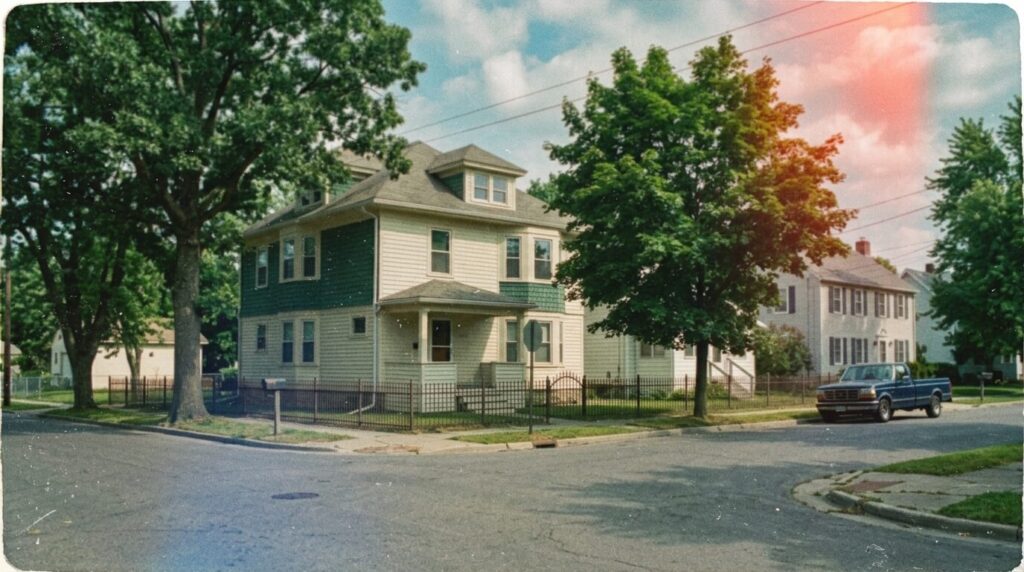
The One-Million-Dollar Order This is a spectacular case study for the 1915-1918 kit home boom. Facing a housing shortage for its coal miners, the Standard Oil Company placed a single, massive $1 million order for 152 Sears catalog homes. The neighborhood, known as the Standard Addition, consists of eight distinct blocky Craftsman and Foursquare models built side-by-side in record time. It remains wonderfully intact today. Documented extensively by historic preservation societies, you can easily source royalty-free images of these repetitive, charming bungalow streetscapes.
4. The Chicago Bungalow Belt (Chicago, Illinois)

The Brick Adaptation While much of the country was building wooden kit homes, Chicago adapted the 1915 Craftsman bungalow boom to fit its strict urban fire codes. The result was the “Chicago Bungalow”—a distinct, sturdy, brick-built home with a low-pitched roof, generous windows, and beautiful limestone detailing. Nearly 80,000 of these were built, creating the legendary “Bungalow Belt.” As a recognized historic building type with its own dedicated preservation association, finding high-quality, open-source photos of these uninterrupted brick streetscapes is exceptionally easy.
5. The Hogue House / Sears “Saratoga” Model (Chelsea, Oklahoma)

The High-End Catalog Dream It is important to show that kit homes weren’t always small. The Hogue House, built around 1912-1915, is a verified Sears “Saratoga” model—one of the largest and most expensive Craftsman homes the catalog offered. It features an expansive wraparound porch, heavily rusticated stone pillars, and beautiful dormers. Listed on the National Register of Historic Places, it is a magnificent standalone example of catalog luxury. Because of its registry status, free-to-use structural and architectural photography is readily available.
6. Del Ray Historic District (Alexandria, Virginia)
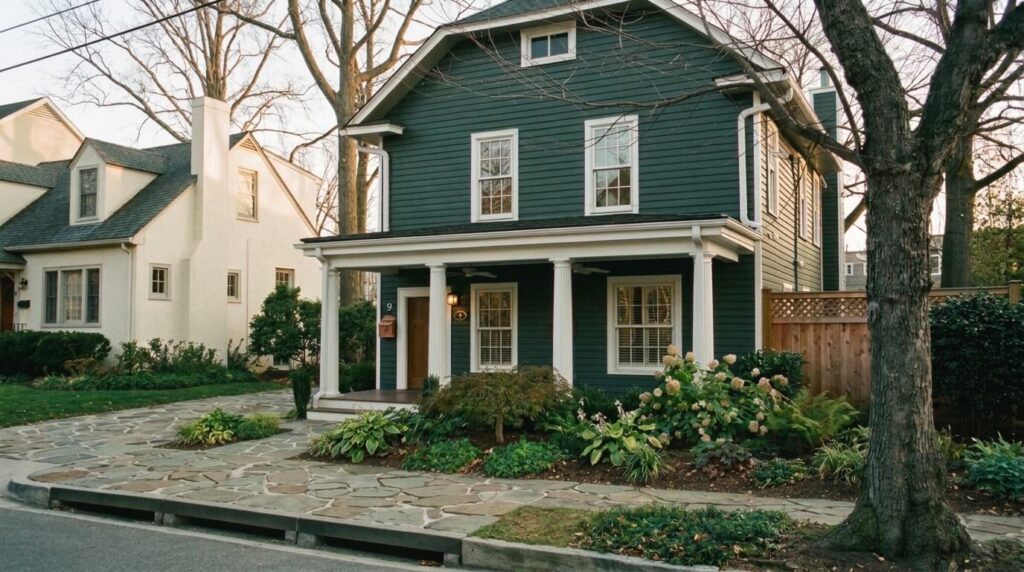
The Streetcar Suburb Explosion Del Ray perfectly illustrates how the 1915 bungalow boom physically expanded American cities. Developed specifically as a “streetcar suburb” for commuters working in Washington D.C., the neighborhood was rapidly filled with kit homes from Sears, Aladdin, and Lewis Manufacturing. The district is a textbook example of middle-class 1910s expansion, packed with deep-porched Craftsman homes sitting on narrow, walkable lots. As a celebrated local historic district, photographers have uploaded countless royalty-free images of its charming, varied bungalow architecture.
+1


