Return to Nature: 6 Landmarks of 1970s Earth-Tone Contemporary
1. New Mark Commons (Rockville, Maryland)
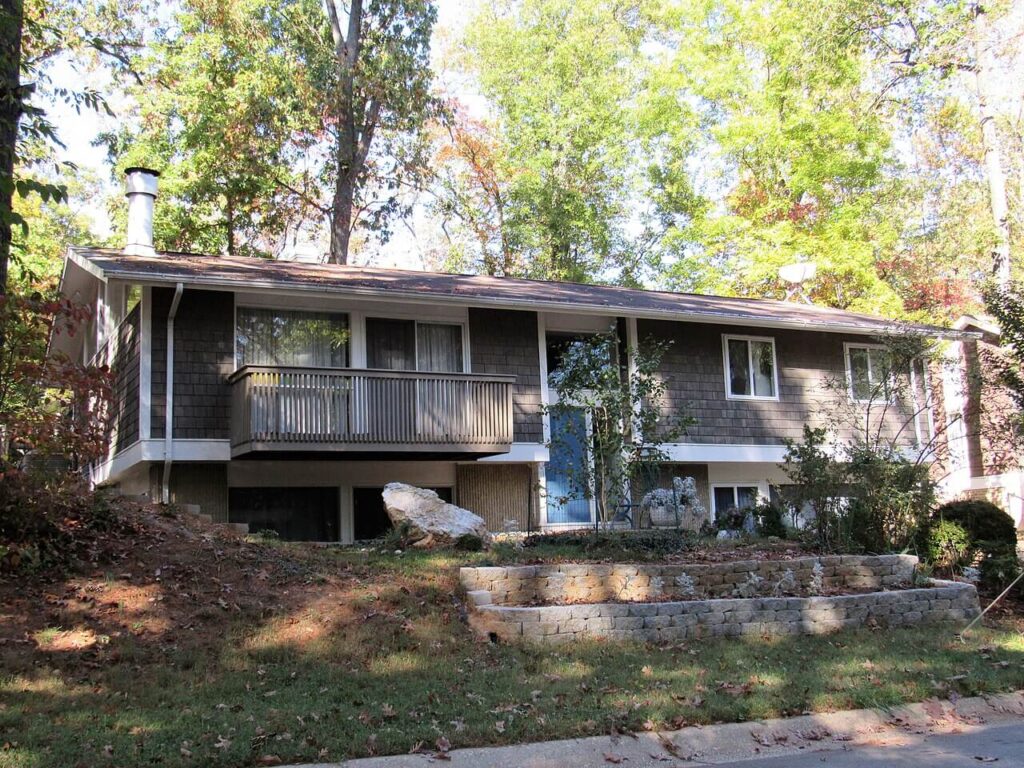
The Quintessential “Shed Style” Suburb Constructed between 1967 and 1973, New Mark Commons is the ultimate textbook example of the “Shed Style” trickling down into mainstream suburban development. Designed by Keyes, Lethbridge & Condon, the neighborhood completely rejected the traditional boxy Colonial. Instead, the homes feature steeply pitched, asymmetrical shed roofs, diagonal wood siding, and dark earth-tone paints specifically chosen so the houses would camouflage into the surrounding trees. Recently added to the National Register of Historic Places, finding high-quality, copyright-free photography of these geometric, wood-clad homes is incredibly easy.
2. Village Homes (Davis, California)
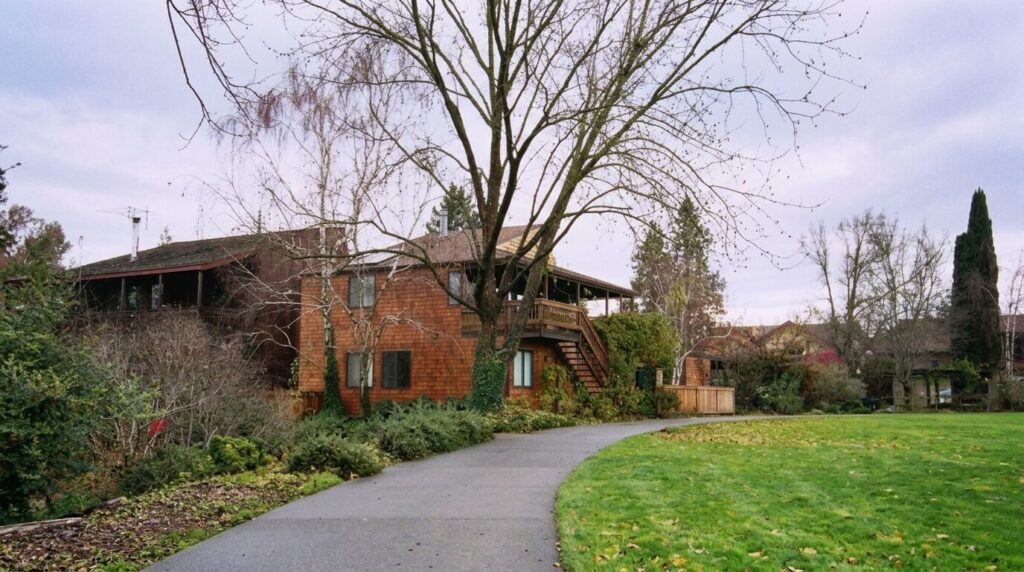
The 1970s Eco-Utopia Developed in 1975 by Michael and Judy Corbett, Village Homes was a radical response to the 1970s energy crisis and the peak of earth-tone ecological architecture. The developers completely abandoned the traditional street grid. Instead, every single house in the massive subdivision was oriented on an east-west axis to maximize passive solar heating. The neighborhood featured early solar panels, community gardens, and natural drainage swales. As a globally famous milestone in sustainable urban planning, federal and academic archives hold vast amounts of royalty-free imagery of its sun-drenched, rustic contemporary architecture.
3. Lindal Cedar “A-Frame” Kit Homes (Nationwide)

The 1970s Leisure Boom The 1970s was the golden age of the American second home, and the A-Frame cabin became its undisputed mascot. Companies like Lindal Cedar Homes mass-produced these striking, geometric structures as pre-cut kits. The A-Frame was the ultimate expression of the 70s contemporary vibe: a structure built almost entirely of exposed natural cedar, featuring a soaring vaulted interior and a massive wall of trapezoidal glass looking out into the woods or ski slopes. Vintage 1970s mail-order catalogs and modern open-source architectural photography provide brilliant, colorful assets for this iconic shape.
4. The Korman House (Fort Washington, Pennsylvania)

The High-Art Wood Contemporary Designed in 1971 by the legendary architect Louis Kahn, the Korman House shows what the 1970s wood-and-earth aesthetic looked like with an unlimited budget. It is Kahn’s final residential masterpiece. The home is an awe-inspiring composition of towering, warm cypress wood, massive brick chimneys, and colossal two-story windows. It perfectly captures the 1970s desire for monumental spaces built from raw, natural materials. Heavily studied by architectural historians, the public domain is rich with spectacular structural photography of its flawless geometric exterior.
5. Buckminster Fuller Dome Home (Carbondale, Illinois)

The Geodesic Counterculture While Fuller built his personal dome home in 1960, the Geodesic Dome exploded into a massive, mainstream DIY housing craze during the 1970s, heavily fueled by the Whole Earth Catalog. The dome was embraced by the counterculture as the ultimate cheap, energy-efficient, anti-establishment home. Thousands of these futuristic yet earthy structures were built across rural America, often utilizing wood shingles and triangular skylights. Fuller’s restored home in Illinois is a protected historic landmark, making royalty-free imagery of its unique, spherical geometry highly accessible.
6. The Villages of Irvine (Irvine, California)

The Master-Planned Earth-Tone Suburb During the 1970s, the Irvine Company transformed a massive Southern California ranch into the largest master-planned city in North America. Villages like Turtle Rock and Woodbridge (started in the mid-1970s) defined the mainstream California Contemporary look. Developers rolled out endless tracts of homes featuring heavily textured stucco, dark brown heavy-timber trim, vaulted ceilings, and prominent clerestory windows. These neighborhoods successfully packaged the rugged, custom “woodsy” aesthetic into mass-produced, highly desirable suburban sprawl. Local historical surveys offer plenty of open-source imagery of Irvine’s rapid 1970s expansion.